In This Article
The 2026 Korean film Hope arrived with immense anticipation, fresh from a 7-minute standing ovation at the Cannes Film Festival. International critics heralded it as a genre-bending spectacle, a potential cult classic. Yet, a stark divide emerged between its roaring pre-release hype and the mixed reviews from its initial domestic audience, sparking significant Hope criticism.
*** Spoiler Warning ***
This article contains spoilers for Hope(2026). Reader discretion is advised.
- Hope received a 7-minute standing ovation at Cannes, but faced polarized domestic reviews.
- Audiences praised its stunning visuals, immersive quality, and intense action sequences.
- Common criticisms included dull dialogue, a perceived stale storyline, and uninspired visual effects.
- The film’s blend of B-movie humor and Director Na Hong-jin’s stylistic shift contributed to divided opinions.
Initial Public Reception and CGV Egg Score Trends
Public perception of Hope shifted rapidly after its debut. The CGV Egg Score, a unique Korean audience rating system, started at 89% but dropped to 83% on opening day. By July 18, 2026, it had fallen further to 81%, indicating a cooling reception. Some audience members posted harsh reviews on opening day. Others engaged in deeper, more interpretative discussions. This marked a distinct shift from the initial widespread acclaim.
Elements Praised in ‘Hope’
Even amid shifting public opinion, Hope garnered specific praise. Audiences lauded the film’s stunning visuals, immersive quality, and the actors’ captivating performances. Director Na Hong-jin’s grand directorial scale and intense action sequences earned particular acclaim. Viewers highlighted the thrilling, fast-paced narrative, the exhilarating chase scenes, and the unique action choreography rarely seen in Korean cinema. The precision of the chase sequences, the dense cinematography, and the overall entertainment value were consistently celebrated.
Why So Many Viewers Walked Away Disappointed
Negative reactions weren’t limited to a single issue. Instead, Korean audience repeatedly pointed to the same handful of frustrations, creating a surprisingly consistent pattern across thousands of reviews.
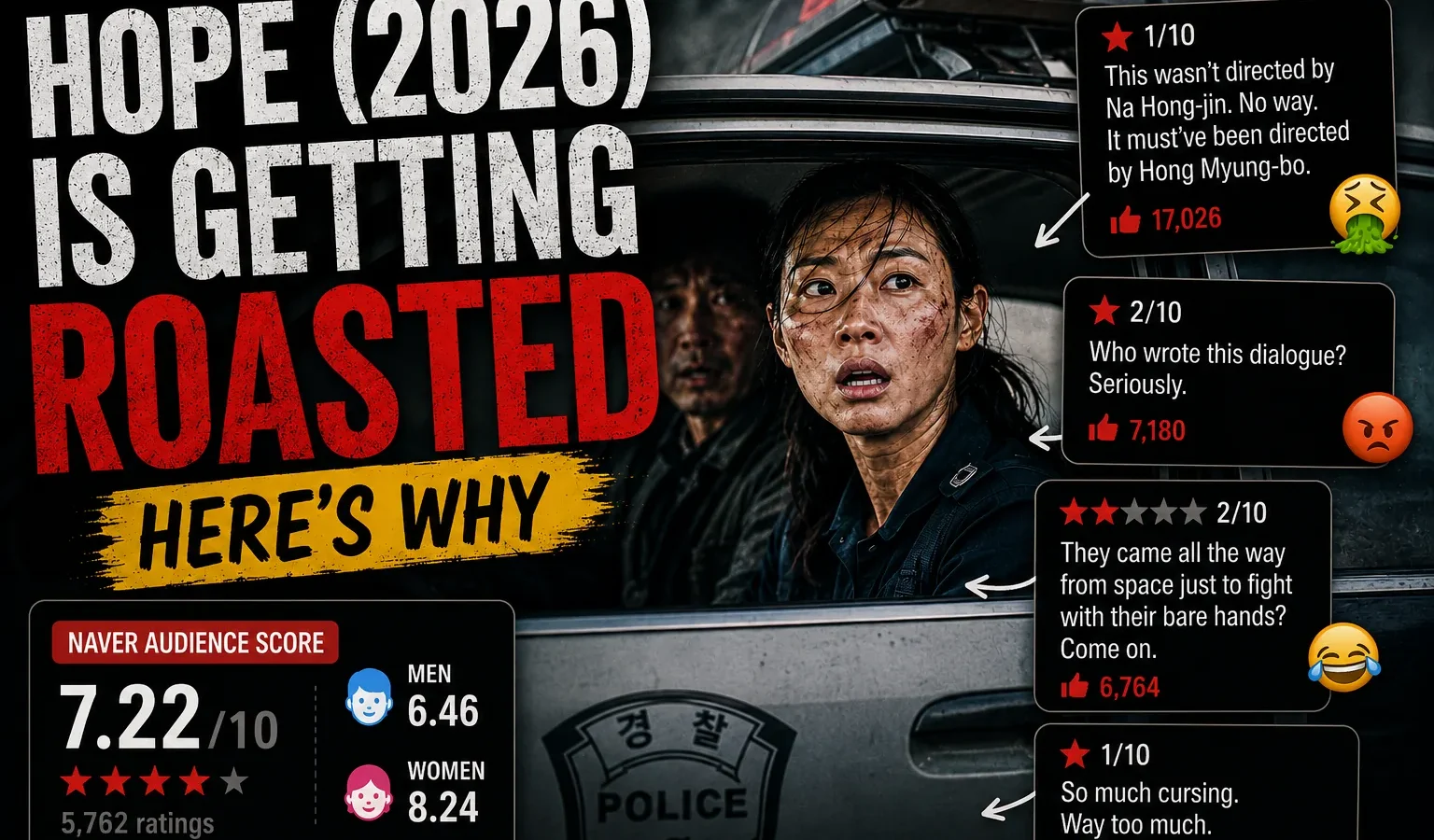
“Who wrote this dialogue? Seriously”
The dialogue quickly became one of the film’s biggest targets. Rather than criticizing specific lines, many viewers questioned the overall writing. One of the most recommended reviews on Naver simply asked: “Who wrote this dialogue?” Others described the conversations as awkward, unnatural, and occasionally.
Great Expectations Made the Disappointment Even Bigger
Perhaps the most talked-about comment online wasn’t even a review — it was a joke. One Naver user wrote :
“There is no way Na Hong-jin directed this. It must’ve been directed by Hong Myung-bo.”
The comment received more than 17,000 recommendations, quickly becoming one of the most widely shared reactions after release. For international readers, the joke is especially telling.
Hong Myung-bo is one of Korea’s best-known football managers, not a filmmaker. The punchline wasn’t really about football—it reflected how shocking the gap felt between the enormous expectations surrounding Na Hong-jin’s return and the finished film.
“They Came All the Way From Space for This?”
The final act also drew heavy criticism. Many viewers questioned the logic behind the action sequences, particularly the decision to have an advanced alien species engage in repeated hand-to-hand combat with humans. Others felt the climax became repetitive, arguing that the tension gradually faded instead of escalating toward the ending.
CGI, Creature Design, and an Identity Crisis
Visual effect also became a frequent topic of discussion. While some praised the film’s ambition, many felt the CGI didn’t live up to expectations for one of Korea’s biggest productions. The creature design itself also divided audiences, with some comparing it unfavorably to franchises such as Attack on Titan or Avatar.
Beyond the visuals, many viewers struggled to describe what kind of movie Hope was trying to be. Horror, sci-fi, survival thriller, family drama, and dark comedy all appeared throughout the film, but many audiences felt these elements never fully came together into a cohesive whole.
Closing Thoughts
This article has focused primarily on the criticisms surrounding Hope (2026) in order to explore why the film sparked such intense disappointment among many Korean moviegoers. However, that is only one side of the story.
Despite the polarized reactions, Hope has remained a commercial success, surpassing two million admissions in one of the fastest timeframes in Korean box office history after its release. The film has also received enthusiastic praise from many critics and audiences alike. Among its strongest supporters is renowned Korean film critic Lee Dong-jin, whose review offers a strikingly different perspective:
“A boldly charging film that transforms its bizarre chaos into one enormous crescendo.“
Ultimately, no single review can define a film. Whether Hope feels like an ambitious masterpiece or a frustrating disappointment is something each viewer should decide for themselves.
In the next article, I’ll share my own interpretation of several scenes that divided audiences—and why some of the film’s most criticized moments worked very differently for me.